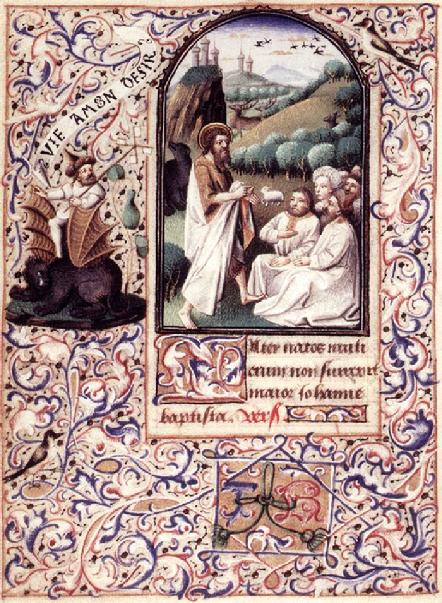
detail, Unknown Illustrator of Petrus Comestor's Bible Historiale, 1372
John said to the crowds that came out to be baptized by him, "You brood of vipers! Who warned you to flee from the wrath to come? Bear fruits worthy of repentance. Do not begin to say to yourselves, 'We have Abraham as our ancestor'; for I tell you, God is able from these stones to raise up children to Abraham. Even now the ax is lying at the root of the trees; every tree therefore that does not bear good fruit is cut down and thrown into the fire." And the crowds asked him, "What then should we do?" In reply he said to them, "Whoever has two coats must share with anyone who has none; and whoever has food must do likewise." Even tax collectors came to be baptized, and they asked him, "Teacher, what should we do?" He said to them, "Collect no more than the amount prescribed for you." Soldiers also asked him, "And we, what should we do?" He said to them, "Do not extort money from anyone by threats or false accusation, and be satisfied with your wages." As the people were filled with expectation, and all were questioning in their hearts concerning John, whether he might be the Messiah, John answered all of them by saying, "I baptize you with water; but one who is more powerful than I is coming; I am not worthy to untie the thong of his sandals. He will baptize you with the Holy Spirit and fire. His winnowing fork is in his hand, to clear his threshing floor and to gather the wheat into his granary; but the chaff he will burn with unquenchable fire." So, with many other exhortations, he proclaimed the good news to the people. -Luke 3:7-18
Self-Guided Retreat
Once the hypocrites (you brood of vipers!) have left the scene, John’s voice is gentle. So what should we do? the people ask. Share what you have, he answers simply. What should we do? ask the tax collectors. Don’t cheat people. What should we do? ask the soldiers. Don’t bully people. That’s all. John the Baptist’s kindness toward the repentant and much-hated tax-collectors and soldiers prefigures Jesus' own love for them, as well as prostitutes, sinners of all kinds, women and children.
So what must I do? Get out of the cave and put on reality (Meditation One). What must I do? Repent and revel in God’s love for me (Meditation Two). What must I do? Invite the oppressors and the oppressed to the meal of kindness (Meditation Three).
Enjoy the challenges of this week’s soul-work. - Suzanne
Meditation One (Introit)
What Must I Do?
What must be the first step of the self upon this road to perfect union with the Absolute?Clearly, a getting rid of all those elements of normal experience which are not in harmony with reality: of illusion, evil, imperfection of every kind.… A literal and deliberate getting out of the cave must be for every mystic, as it was for Plato’s prisoners, the first step in the individual hunt for reality. … Primarily, then, the self must be purged of all that stands between it and goodness: putting on the character of reality instead of the character of illusion or “sin.” It longs ardently to do this from the first moment in which it sees itself in the all-revealing radiance of the Uncreated Light.
-EvelynUnderhill, 1875-1941 Mysticismp.198-199
The Advent mystery is the beginning of the end of all in us that is not yet Christ.
-Thomas Merton 1915-1968
MISCELLANY
Therefore I say: In every gift, in every work, we ought to learn to look toward God, and we should not allow ourselves to be satisfied or be detained by any thing. Whatever our way of life may be, we must not cease to progress; this has been true for everyone, however far he may have advanced. Above all else, we should always be preparing ourselves, always renewing ourselves to receive God's gifts.
-Meister Eckhart 1260-1327 Quoted from Ordinary Graces: Christian Teachings on the Interior Life
For although [Mary Magdalene] could never rid herself of the deep sorrow of her heart for her sins, all her lifetime she carried them with her wherever she went, as it were in a bundle bound together and stored secretly in the cavern of her heart, in a way that could never be forgotten. Yet it still can be said, and is affirmed by holy scripture, that she had a greater sorrow of heart for her lack of love than for any awareness of her sins. She had a more sorrowing desire, a deeper sighing; she languished almost to the point of death for her lack of love, though she had very great love. And we are not to wonder at this; for it is the nature of a true lover that the more he loves the more he longs to love.
-The Cloud of Unknowing, 14th Century Paulist Press 1981
John the Baptist Preaching, French Miniaturist, Folio Breviary 1455
Meditation Two (Insight)
True Repentance
True repentance, then, is not an expression of fear, self-hate or of a neurotic sense of guilt, but an ordinary , simple, natural way of loving God. It is a meeting with God, who has loved us infinitely, whom we love and whose beauty and perfection we long to see, from whom we are separated by sin. True repentance, holy repentance, is the way of love. It is only possible when we stand before the face of God and are moved "out of our minds," beyond the confines of our little narrow selves, by our longing for him.
-Irma Zaleski The Way of Repentance, Novalis/Continuum 1999
The man who knows his sins is greater than one who raises a dead man by his prayer. .... He who sighs and grieves within himself for an hour is greater than one who teaches the entire universe. He who knows his own weakness is greater than one who sees angels. ... He who follows Christ, alone and contrite, is greater than one who enjoys the favor of crowds in the churches.
-St. Isaac the Syrian, d.circa 700, (Discourse 34)
Meditation Three (Integration)
The Meal Of Kindness
Since we ourselves are human beings, we must set before others the meal of kindness no matter why they need it – whether because they are widows, orphans, or exiles; or because they are brutalized by masters, crushed by rulers, dehumanized by tax-collectors, bloodied by robbers, or victimized by the insatiate greed of thieves, be it through confiscation of property or ship-wreck. All such people are equally deserving of mercy, and they look to us for their needs just as we look to God for ours.
-Gregory of Nazianzus d.389 oration14, On the Love of the Poor, quoted from J. Robert Wright, Readings for the Daily Office from the Early Church
The Last Word
Our ego is the agent that does not allow the bundle of desires, drives, and needs in us to come to resolution. That is precisely how it shores up in us such a profound dependency on this world. …
… The process wherein the ego ceases to forget God is the same as the one wherein it begins to forget itself.
-Dorothee Soelle The Silent Cry: Mysticism and Resistance (2001)
Suzanne's Meditation
John the Baptist says to the shallow and cynical side of my soul, “You brood of vipers!” He speaks forcefully to my unconscious collusion with the oppressive powers of my culture and society and our collective and my personal degradation of the environment. I can't ignore that I live a certain life style at the expense of exploited people around the world who I do not see, who receive our garbage, our toxic waste, who supply us with cheap goods and services while working in slave conditions. I'm implicated in the powers that promote consumerism, monoculture, and unending short term gratification at the expense of earth and peoples and generations to come and even life itself.
But John speaks gently to the humble, even the most hated inhabitants of his country. The sinners, including tax collectors and soldiers who nervously listen to John's condemnation of the hypocrites, ask, What should I do? To tax collectors he says, “Don't cheat.” To soldiers he says, “Don't bully.” (Luke 3:10-14). To me, he says, “Just try.”
He invites me, and the tax collectors and soldiers and sinners to the Jordan for a ritual cleansing. He says, The One who is Coming, who is mightier than I, whose sandal I'm not worthy to stoop down and untie, will call you to leave your tax collector's booth, he will forgive you as you pound his flesh into the wood of the cross, he will baptize you with fire.