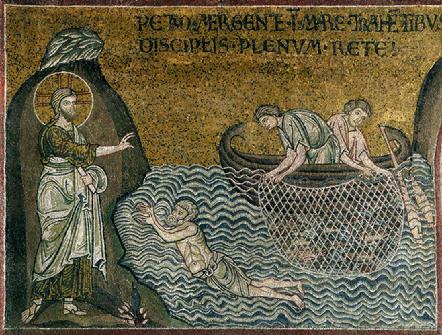
After these things Jesus showed himself again to the disciples by the Sea of Tiberias; and he showed himself in this way. Gathered there together were Simon Peter, Thomas called the Twin, Nathanael of Cana in Galilee, the sons of Zebedee, and two others of his disciples. Simon Peter said to them, "I am going fishing." They said to him, "We will go with you." They went out and got into the boat, but that night they caught nothing. Just after daybreak, Jesus stood on the beach; but the disciples did not know that it was Jesus. Jesus said to them, "Children, you have no fish, have you?" They answered him, "No." He said to them, "Cast the net to the right side of the boat, and you will find some." So they cast it, and now they were not able to haul it in because there were so many fish. That disciple whom Jesus loved said to Peter, "It is the Lord!" When Simon Peter heard that it was the Lord, he put on some clothes, for he was naked, and jumped into the sea. But the other disciples came in the boat, dragging the net full of fish, for they were not far from the land, only about a hundred yards off. When they had gone ashore, they saw a charcoal fire there, with fish on it, and bread. Jesus said to them, "Bring some of the fish that you have just caught." So Simon Peter went aboard and hauled the net ashore, full of large fish, a hundred fifty-three of them; and though there were so many, the net was not torn. Jesus said to them, "Come and have breakfast." Now none of the disciples dared to ask him, "Who are you?" because they knew it was the Lord. Jesus came and took the bread and gave it to them, and did the same with the fish. This was now the third time that Jesus appeared to the disciples after he was raised from the dead.
When they had finished breakfast, Jesus said to Simon Peter, "Simon son of John, do you love me more than these?" He said to him, "Yes, Lord; you know that I love you." Jesus said to him, "Feed my lambs." A second time he said to him, "Simon son of John, do you love me?" He said to him, "Yes, Lord; you know that I love you." Jesus said to him, "Tend my sheep." He said to him the third time, "Simon son of John, do you love me?" Peter felt hurt because he said to him the third time, "Do you love me?" And he said to him, "Lord, you know everything; you know that I love you." Jesus said to him, "Feed my sheep.
Very truly, I tell you, when you were younger, you used to fasten your own belt and to go wherever you wished. But when you grow old, you will stretch out your hands, and someone else will fasten a belt around you and take you where you do not wish to go." (He said this to indicate the kind of death by which he would glorify God.) After this he said to him, "Follow me." -John 21:1-19
Self-Guided Retreat
Part 1
On This Week's Prompts for Personal Meditation
Oh, Peter! So vulnerable, clueless, headstrong, weak-minded. I'm grateful for Peter's character. I could say "let's build three booths" or "wash all of me" or "I'll never deny thee!" I denied the Christ far more than three times, and yet I'd be just as hurt if I were asked, "Do you love me?" Meditating on these texts I once again realized I'm far more an admirer of Jesus than a follower. But Peter eventually rises to the apostolic opportunity and sets out upon the road of service and self-sacrifice. With the three-fold denial and three-fold affirmation in mind I chose quotes about getting a late start. Referencing Jesus' parable of the workers hired late in the day, Chrysostom proclaims the universality of the feast through the Easter mystery (meditation one). Augustine laments time lost but revels in the present embrace of the divine (meditation two). Merton reflects upon discovering that sanctity has more to do with finding our authentic, flawed selves than acquiring extraneous qualities (meditation three). Peter is a saint because of his character flaws. It's often true, isn't it, that God's power is made perfect in (our) weakness? So, like the prodigal, let us enter the banquet hall of Easter.
"The table is rich-laden; feast royally, all of you! The calf is fattened; let no one go forth hungry! Let all partake of the Feast of Faith. Let all receive the riches of goodness. Let none lament their poverty, for the Universal Kingdom has been revealed." - John Chrysostom Have a good meditation, Suzanne
Meditation One (introit) Even at the Eleventh Hour If anyone has labored from the first hour, today receive your just reward. If anyone has come at the third hour, with thanksgiving keep the feast. If anyone has arrived at the sixth hour, have no misgivings; for you shall suffer no loss. If anyone has delayed until the ninth hour, draw near without hesitation. If anyone has arrived even at the eleventh hour, do not fear on account of your delay. For the Lord is gracious, and receives the last even as the first; He gives rest to the one that comes at the eleventh hour, just as to the one who has labored from the first. He has mercy upon the last, and cares for the first; to the one He gives, and to the other He is gracious. He both honors the work, and praises the intention.
Enter all of you, therefore, into the joy of our Lord, and whether first or last receive your reward. O rich and poor, one with another, dance for joy! O you ascetics and you negligent, celebrate the Day! You that have fasted and you that have disregarded the fast, rejoice today! The table is rich-laden; feast royally, all of you! The calf is fattened; let no one go forth hungry!
Let all partake of the Feast of Faith. Let all receive the riches of goodness. Let none lament their poverty, for the Universal Kingdom has been revealed. -John Chrysostom 347-07 The Easter Homily
Meditation Two (insight) Late Have I Loved You Late have I loved you, beauty so old and so new: late have I loved you. And see, you were within and I was in the external world and sought you there, and in my unlovely state I plunged into those lovely created things which you made. You were with me, and I was not with you. The lovely things kept me far from you, though if they did not have their existence in you, they had no existence at all. You called and cried out loud and shattered my deafness. You were radiant and resplendent, you put to flight my blindness. You were fragrant, and I drew in my breath and now pant after you. I tasted you, and I feel but hunger and thirst for you. You touched me, and I am set on fire to attain the peace which is yours. -St. Augustine 354-430 Confessions (trans. Henry Chadwick)
Meditation Three (integration) Being Myself A tree gives glory to God by being a tree. For in being what God means it to be it is obeying him. It "consents," so to speak, to his creative love. It is expressing an idea which is in God and which is not distinct from the essence of God, and therefore a tree imitates God by being a tree. The more a tree is like itself, the more it is like him. If it tried to be like something else which it was never intended to be, it would be less like God and therefore it would give him less glory. For me to be a saint means to be myself. Therefore the problem of sanctity and salvation is in fact the problem of finding out who I am and of discovering my true self. Trees and animals have no problem. God makes them what they are without consulting them, and they are perfectly satisfied.
With us it is different. God leaves us free to be whatever we like. We can be ourselves or not, as we please. Thomas Merton 1915-1968 The New Seeds of Contemplation quoted from Easter, Liturgy Training Publications, Easter
The Last Word We are apt to mistake our vocation by looking out of the way for occasions to exercise great and rare virtues, and by stepping over the ordinary ones that lie directly in the road before us.
-Hannah More 1745-1833
Suzanne's Meditation
Making Adustments
detail, the calling of Peter and Andrew, Duccio, 1308-11
The disciples have been night-fishing, but as dawn breaks they have nothing to show for their efforts. Jesus appears on the shore, too far away to help. He shouts at them to fish differently, to throw their nets on the unconventional side of the boat. That's where they find what they're looking for.
-Richard Beard from the novel, Lazarus is Dead (p.219)
Is it possible that finding what I'm looking requires just the slightest adjustment in my way of seeing? How can pulling up my net, moving it a few feet over, throwing it back in the same waters, make a difference? And yet...
What other slight adjustments to my life, my character, my thinking, my relating to family, friends, neighbors, the world, might change barrenness to fecundity? At any given moment there's probably at least 153 ways to begin.
Do you remember the dynamic between the two disciples running to the tomb on Easter Morning? Mary Magdalene, having found the tomb empty runs to wherever the disciples have been hiding and brings back Peter and John. John outruns Peter but hesitates to go in. When Peter arrives he enters the tomb and sees the disarray of cloths. “Then the other disciple, who reached the tomb first, also went in, and he saw and believed” (John 20:8).
John understands. Peter acts.
Here in the boat, the stranger on the shore calls to the men in the boat. Children, have you caught anything? No? Cast your net on the right side of the boat and you'll catch some. And they did. And could hardly manage the haul of fish. “The disciple who Jesus loved said to Peter, “It is the Lord!”
Peter, who is naked, throws on his clothes and jumps into the water to swim toward shore, leaving the others to manage the miraculous catch of fish.
John understands. Peter acts.
When I act first, perhaps I need to understand more. When I understand and fail to act, well, that's another adjustment I need to make.
-Suzanne
The miraculous catch of 153 fish is reminiscent of the miraculous catch of fish early in the Gospel stories. "Depart from me I am a sinful man," says Peter. The Miraculous Draught of Fishes, Raffaello, 1515, detail
Italian Mosaic Artist, Cathedral Monreale, 1180's
Part 2
Accepting Absolution
Rooster With a Censor, Walters Museum, MS W102
When they had finished breakfast, Jesus said to Simon Peter, "Simon son of John, do you love me more than these?" He said to him, "Yes, Lord; you know that I love you." Jesus said to him, "Feed my lambs." A second time he said to him, "Simon son of John, do you love me?" He said to him, "Yes, Lord; you know that I love you." Jesus said to him, "Tend my sheep." He said to him the third time, "Simon son of John, do you love me?" Peter felt hurt because he said to him the third time, "Do you love me?" And he said to him, "Lord, you know everything; you know that I love you." Jesus said to him, "Feed my sheep. -John 21:15-17
Why three times? Do you love me, do you love me, do you love me? Perhaps Jesus knew that Peter's following through with his commission to tend to the flock depended upon Peter's freedom from his grief and shame. Jesus repeated his question three times for the three times of betrayal before the cock crowed the night of Jesus' arrest. The three-fold question gave Peter the opportunity to accept Jesus' absolution.
Why is it so difficult to accept absolution? Why do we behave as if we would rather cling to our unique sinning than go on in freedom? I collected some quotes here to help think about it.
- Suzanne
Remind me ten times and more of all that you have forgiven me -
without even waiting for my sorrow, the very instant that I slipped and sinned.
Remind me ten thousand times and more of your endless absolution,
not even sorrow required on my part, so broad the bounty of your love.
Yes, I can – I will – forgive as you have forgiven me.
-Edward Hays Prayers for a Planetary Pilgrim
The horse drops dung in the stable. Although the dung is unclean and evil smelling, the same horse laboriously pulls the same dung to the fields where fine wheat and good sweet wine grow from it which would never grow so well if the dung were not there. Now, your own faults, of which you cannot rid yourself or overcome are your dung. There you should carry with much effort and labor to the field of God's will in true detachment from yourself. Scatter your dung on this noble field and, without any doubt, there shall spring up noble and delightful fruit.
-Johannes Tauler 1300-1361 Sermon 6
A soldier asked Abba Mius if God accepted repentance. After the old man had taught him many things he said, "Tell me, my dear, if your cloak is torn, do you throw it away?" He replied, "No, I mend it and use it again." The old man said to him, "If you are so careful about your cloak, will not God be equally careful about his creature?"
- Sayings of the Desert Fathers trans. Benedicta Ward
Some of us have trouble accepting the absolution offered by God through the church. We believe our sins are so unique they are unforgivable. We cling to the self-identity our sin offers us. We refuse to believe that God, the church, our fellows, have the authority to forgive. We refuse to believe that the Holy Spirit can work in us, heal us, transform us.
Developing a mindset of forgiveness rather than resentment can help. Practicing forgiveness helps illuminate the cycle of forgiveness. Ambrose of Milan said, “Christ urges you, when you ask forgiveness for yourself, to be especially generous to others, so that your actions may commend your prayer.” Forgive us our sins as we forgive those who sin against us. Entering the cycle of forgiveness can help convince us of the reality of absolution. God's totally positive and lasting way of removing our shortcomings is to fill up the hole with something much better, more luminous, and more satisfying.
-Richard Rohr, Breathing Under Water
We can so easily make ourselves victims of our own thoughts and feelings of guilt and shame for what we have done. Make no mistake, we must be accountable for our actions, but when we stay stuck in the unhappy story of what we have done – when we make an identity out of our past actions – we deny ourselves the gift of transformation. We can all learn from the mistakes of our past. Learning from the past is not the same as being held hostage by what we have done. At some stage we must let go of the past and begin again. We have said repeatedly that no one is undeserving of forgiveness, and this includes you.
Once in a saintly passion I cried with desperate grief, “O Lord, my heart is black with guile, Of sinners I am chief.” Then stooped my guardian angel and whispered from behind, “Vanity, my little man, You're nothing of the kind.”
-James Thomson
O Lord Jesus Christ, look upon us with those eyes of thine where-with thou didst look upon Peter in the hall; that with Peter we may repent and, by the same love be forgiven; for thine mercy's sake. Amen.
- Lancelot Andrewes 1555-1626
Now there is rejoicing in heaven; for you were lost, and are found; you were dead, and are now alive in Christ Jesus our Lord. Go (abide) in peace. The Lord has put away all your sins.
-Book of Common Prayer p451
Part 3 "Follow Me"
Quo Vadis?
Very truly, I tell you, when you were younger, you used to fasten your own belt and to go wherever you wished. But when you grow old, you will stretch out your hands, and someone else will fasten a belt around you and take you where you do not wish to go." (He said this to indicate the kind of death by which he would glorify God.) After this he said to him, "Follow me." John 21:18-19
And as they considered these things, Xanthippe took knowledge of the counsel of her husband with Agrippa, and sent and showed Peter, that he might depart from Rome. And the rest of the brethren, together with Marcellus, besought him to depart. But Peter said unto them: Shall we be runaways, brethren? and they said to him: Nay, but that thou mayest yet be able to serve the Lord. And he obeyed the brethren's voice and went forth alone, saying: Let none of you come forth with me, but I will go forth alone, having changed the fashion of mine apparel. And as he went forth of the city, he saw the Lord entering into Rome. And when he saw him, he said: Lord, whither goest thou thus (or here)? And the Lord said unto him: I go into Rome to be crucified. And Peter said unto him: Lord, art thou (being) crucified again? He said unto him: Yea, Peter, I am (being) crucified again. And Peter came to himself: and having beheld the Lord ascending up into heaven, he returned to Rome, rejoicing, and glorifying the Lord, for that he said: I am being crucified: the which was about to befall Peter.
He went up therefore again unto the brethren, and told them that which had been seen by him: and they lamented in soul, weeping and saying: We beseech thee, Peter, take thought for us that are young. And Peter said unto them: If it be the Lord's will, it cometh to pass, even if we will it not; but for you, the Lord is able to stablish you in his faith, and will found you therein and make you spread abroad, whom he himself hath planted, that ye also may plant others through him. But I, so long as the Lord will that I be in the flesh, resist not; and again if he take me to him I rejoice and am glad.