At that very time there were some present who told him about the Galileans whose blood Pilate had mingled with their sacrifices. He asked them, "Do you think that because these Galileans suffered in this way they were worse sinners than all other Galileans? No, I tell you; but unless you repent, you will all perish as they did. Or those eighteen who were killed when the tower of Siloam fell on them--do you think that they were worse offenders than all the others living in Jerusalem? No, I tell you; but unless you repent, you will all perish just as they did." Then he told this parable: "A man had a fig tree planted in his vineyard; and he came looking for fruit on it and found none. So he said to the gardener, 'See here! For three years I have come looking for fruit on this fig tree, and still I find none. Cut it down! Why should it be wasting the soil?' He replied, 'Sir, let it alone for one more year, until I dig around it and put manure on it. If it bears fruit next year, well and good; but if not, you can cut it down.'" Luke 13:1-9
Self-Guided Retreat
Like Advent, today's Gospel puts impending apocalypse and the urgent call to repentance ahead of business as usual. Never before has this Gospel reading been more thoroughly prescient. The human traits of greed, selfishness, pride and ignorance places all of humanity, innocent and guilty, in peril. True change of heart, personal and global, MIGHT save us.
My own meditations this week focused on the gardener's suggestion of digging around the fig tree and putting manure on it. I thought about composting, and about humus - that living, breathing, potent source of energy I scoop up in my hands after leaves and grasses and insects decay upon the ground. Humus is the Latin word for earth. Humanity comes from earth (dust thou art and to dust thou shalt return). Humility is being close to the earth - earthiness, honesty.
In Judeo/Christian thought the fig tree symbolizes religious knowledge. Here's what we know - religious and non-religious alike - we know we have to take care of each other and repair and tend our planet home. We've known the danger for several decades. We have very little time.
Repentance, acknowledging the problem and preparing a reparation must be our way of life (Meditation One) if we are to survive. The habit of humility, coming close to the ground, living in truth instead of illusion (Meditation Two) must also be our way of living. The urgency (Meditation Three) is obvious. The Last Word offers a parable about the freedom of repentance and humility.
May the Holy Spirit ground your meditation in sweet earthiness. -Suzanne
Meditation One (Introit) Repentance This life has been given to you for repentance. Do not waste it on vain pursuits. -Isaac of Syria 7th Century Repentance - conversion of the heart - does not mean being filled and tormented by guilt. Instead, it means being ready to admit our responsibility for our actions and our need for forgiveness, and having a firm desire to change our life: to turn away from ourselves in prayer and in love. Repentance means, above all, a constant, patient, growing in love. It means our willingness to open ourselves to the work of the Spirit in us and to embrace fully the gift of our salvation. -Irma Zaleski The Way of Repentance 1999 Repentance is the life of the Spirit within us, a life of truth and of love. -Irma Zaleski
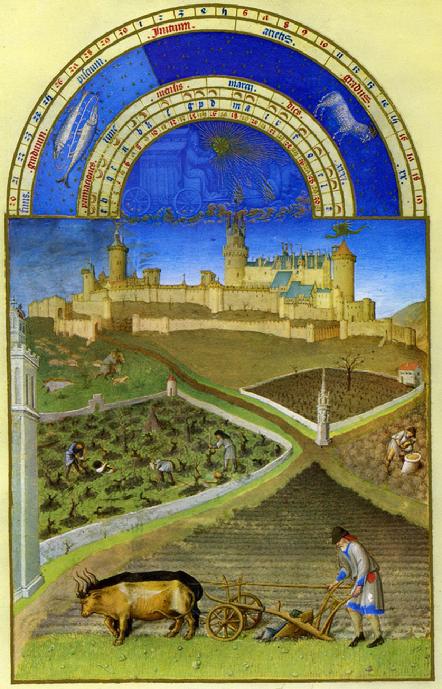
March, Limburg Brothers, Tres Riches Heures, c.1440
Miscellany
And it is not because the mechanism is working wrongly, that I am ill./ I am ill because of wounds to the soul, to the deep emotional self / And wounds to the soul take a long, long time, only time can help /and patience, and a certain difficult repentance, / long, difficult repentance, realization of life's mistake, and the freeing oneself / from the endless repetition of the mistake which mankind at large has chosen to sanctify.
-D.H. Lawrence 1885-1930 “Healing” quoted from the Rag and Bone Shop of the Heart: A Poetry Anthology, edited by Robert Bly, James Hillman, and Michael Meade, Harper, 1992, p.113
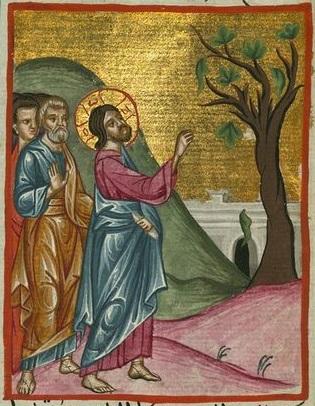
Jesus Cursing the Fig Tree, Mark 11:12-14 (different story from today's Gospel) Walters Museum, MS.W.592, folio 58a
The darkness is not hidden even from itself; though it sees naught else it sees itself. The works of darkness follow it, and there is no hiding place from it, not even in the darkness. This is "the worm that dieth not"—the memory of the past. Once it gets within, or rather is born within though sin, there it stays and never by any means can be plucked out. It never ceases to gnaw the conscience; feeding on it as on food that never can be consumed it prolongs the life of misery. I shudder as I contemplate this biting worm, this never-dying death. I shudder at the thought of this being the victim of this living death, this dying life.
Bernard of Clairvaux 1090-1153 On Consideration
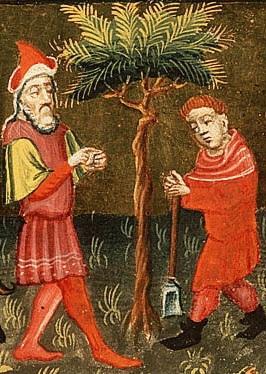
detail, Jesus heals the crippled woman and the Parable of the Fig Tree, Koninklijke Bibliotheek, The Hague, 1430
Meditation Two (Insight) Humility The sin of inadvertence, not being alert, not quite awake, is the sin of missing the moment of life. Live with unremitting awareness; whereas the whole of the art of the non-action that is action (wu-wei) is unremitting alertness. -Joseph Campbell 1904-1987 The Power of Myth (with Bill Moyers) Humility, that low sweet root, From which all heavenly virtues shoot -Thomas More 1477-1535
Ax laid to the root of the tree, Unknown Illustrator of Petrus Comestor's Bible Historiale 1372, Detail
Meditation Three (Integration) Urgency We stand now where two roads diverge . . .the one ‘less traveled by' offers our last, our only chance to reach a destination that assures the preservation of our Earth. -Rachael Carson Silent Spring 1907-1964 The most important things is to actually think about what you do. To become aware and actually think about the effect of what you do on the environment and on society. That's key, and that underlies everything else. -Jane Goodall The greatest danger to our future is apathy. -Jane Goodall
The Last Word
A king visited a prison in his kingdom and talked with the prisoners. Each one insisted on his innocence except for one man who confessed to a theft. “Throw this rascal out of the prison!” cried the king, “He will corrupt the innocents!”
-Hasidic Story
Suzanne's Meditation
Then he told this parable: "A man had a fig tree planted in his vineyard; and he came looking for fruit on it and found none. So he said to the gardener, 'See here! For three years I have come looking for fruit on this fig tree, and still I find none. Cut it down! Why should it be wasting the soil?' He replied, 'Sir, let it alone for one more year, until I dig around it and put manure on it. If it bears fruit next year, well and good; but if not, you can cut it down.'" - Luke 13:6-9
Ruthlessness: the one uncompromising rule of gardening - pruning, chopping, weeding, deadheading, dividing, removing the weak and sick, throwing away the plants that inhibit or crowd the others. Out go the plants that don't produce fruit or function as a helpful neighbor to another plant. Out go plants that do not offer beauty or scent or pleasure or visual interest. I remember one of the interns on the farm remarking, “When I imagined that I'd spend my summer gardening, I never thought that so much of my day would involve killing” – not only plants, but harmful insects and rodents.
In Jesus' parable the owner of the garden observes a barren fig tree. Reasonably, he orders it yanked out. But the gardener suggests that the owner give the fig another year. In the meantime he'll break up the hard earth, aerating the ground around it so the roots can breathe and drink and take in nourishment. He'll put manure around it, that golden substance which is the very ground of life and fertility - changing the very soil nurturing the fig tree.
What blessed good news for my soul! Not only do I have a reprieve, but in that time I will be loved, nurtured, brought back to a life of creative regeneration. The mercy of God may not necessarily reflect good gardening practice, but proves a boon for us clueless procrastinators and late bloomers.
But in the parable, mercy has an expiration date. You can't let the garden languish full of weeds. Repent, says Jesus. You don't know when some tyrant or madman will take your life, or even when some building will fall on you as you walk by. (Luke 13:1-5) The land owner will come yank out that fig sooner or later. Repent. NOW.
Most people live lives so crammed with responsibility it's necessary to push repentance into the background, like many other beautiful and important things. I have all these emergencies to deal with immediately. They occupy my attention like demons screeching and jumping up and down on my desk. Our culture demands that most people live from emergency to emergency. Some day I'll get some time off and go to the desert for 40 days to repent.
Repent, NOW, says Jesus. You do not know the day or hour. (Matthew 25:13)The sense of immanent Death can shake priorities. Suddenly those daily emergencies shrink in fear and slide off the desk when the Great Emergency enters the room with cloak and sickle. Welcome the apparition, say the saints. Day by Day remind yourself that you are going to die, said St. Benedict in the Rule. Anchorites dug a trowel full of dirt from their grave each day, or hemmed their shrouds or slept in their coffins, not for some morbid exercise, but to emphasize life! Breathe now. Look at beauty now. Let the holy in you rise and be fruitful now. Now. Now.
Lent offers the time to develop the habit of repentance in daily life. Lent is the time of aerating the soil and adding humble manure. Time to develop habits of daily repentance. Lent is a time of taking care of things, while being taken care of.
And, to be fair, the detritus pulled from the garden goes to the compost pile. After decomposing it becomes that magic and holy humus nourishing the garden. Ultimately, you can't lose. But you can be creative now.