Easter III "did not our hearts burn..."
Readings for this week can be accessed here.
How often insight occurs indirectly, freed suddenly from the mind’s dusky background, or, slipping in sideways from the unconscious, or, while your eyes, blurry in daydreaming, lose their focus. How often a problem solves itself in twilight sleep, in the shower or garden, while you’ve ceased to concentrate on the puzzle.
I recognized this quality in a drawing by Pieter Cornelisz van Rijck. Click here to see it:
“Kitchen Scene with Supper at Emmaus” . Like a map of the mind, the busy foreground keeps the viewer engaged thoroughly. If the title hadn’t clued me to look for it, my usual exploitive heedlessness would have “kept my eyes from recognizing”the Emmaus event.
Studying the Rijck picture prepared me for the astonishment I felt when I discovered Velazquez’ “Kitchen Maid With Supper at Emmaus” (below, right). Soon after finding the Velazquez, I came upon Denise Levertov’s poem about the painting. (Meditation three) It seems to me the girl watches the event from a reflection in the jar. Even if this isn’t so, she clearly “knows” what is happening behind her. Furthermore, she is rendered more perfectly than the sketchy scene through the doorway or window. The theme of not recognizing and then recognizing Jesus in the post-resurrection stories prepare the soul to perceive the unitive life in unexpected, and sometimes hidden signs.
|
|
Meditation One
“told with closed lips”
Easter is about transformation. This transformation is symbolically, mythically, sacramentally, imaged as death/resurrection, in turn imaged as Baptism. We are trying to undergo the transformation by experiencing the sacramental power of these images. We are following Jesus as our archetype, as well as our teacher and our friend, the one who exemplifies the very transformation we are facing. He is also what is called in Greek the mystagogos, the mystagogue, the one who leads us into the mysteries, the one who initiates us into the secret, into that which is told with closed lips. And he is himself the Way into which he leads us, as he is the Life into which we are led. –Beatrice Bruteau, The Easter Mysteries p.49
Risen Lord, be known to us in the breaking of the bread. American Book of Common Prayer liturgy
A Collect for the Presence of Christ
Lord Jesus, stay with us, for evening is at hand and the day is past; be our companion in the way, kindle our hearts, and awaken hope, that we may know you as you are revealed in Scripture and the breaking of bread. Grant this for the sake of your love. Amen.
-from the evening office (Thursdays) American Book of Common Prayer
|
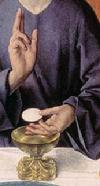 |
| Last Supper, Bouts, 1464, detail |
|
Meditation Two
“though the senses fail to see”
Eucharistic Hymnody (all quotes from the 1982 Hymnal – American Episcopal Church)
Word made flesh, the bread he taketh, by his word his Flesh to be; wine his sacred Blood he maketh, though the senses fail to see; faith alone the true heart waketh to the behold the mystery.
Therefore we, before him bending, this great Sacrament revere; types and shadows have their ending, for the newer rite is here; faith, our outward sense befriending, makes our inward vision clear. -Thomas Aquinas Hymn #329 330-331
Be known to us in breaking bread, and do not then depart; Savior, abide with us, and spread thy table in our heart. -James Montgomery (1771-1854) Hymn #343
Sun, who all my life dost brighten; Light, who dost my soul enlighten; Joy, the best that any knoweth; Fount, whence all my being floweth: at thy feet I cry, my Maker, let me be a fit partaker of this blessed food from heaven, for our good, thy glory, given. Johann Frank(1618-1677) Hymn #339
|
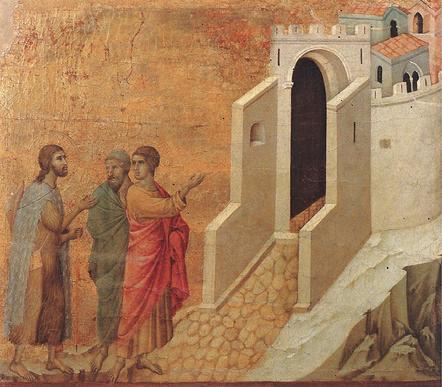 |
| The Road to Emmaus, Duccio, 1308-11 |
|
|
Meditation Three“Kitchen Maid With Supper at Emmaus”
She listens, listens, holding
her breath. Surely that voice
is his - the one
who had looked at her, once, across the crowd,
as no one ever had looked?
Had seen her? Had spoken as if to her?
Surely those hands were his,
taking the platter of bread from hers just now?
Hands he'd laid on the dying and made them well?
Surely that face - ?
The man they'd crucified for sedition and blasphemy.
The man whose body disappeared from its tomb.
The man it was rumored now some women had seen this morning alive?
Those who had brought this stranger home to their table
don't recognize yet with whom they sit.
But she in the kitchen, absently touching the wine jug she's to take in,
a young black servant intently listening,
swings around and sees
the light around him
and is sure.
-Denise Levertov
|
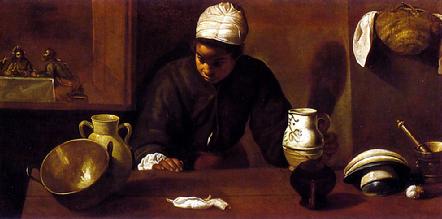 |
| Kitchen Maid With Supper at Emmaus, Velazquez, |
|
|
Collect for Third Sunday after Easter
O God, whose blessed Son made himself known to his disciples in the breaking of bread: Open the eyes of our faith, that we may behold him in all his redeeming work; who lives and reigns with you, in the unity of the Holy Spirit, one God, now and for ever. Amen.
|
|