Easter IV
"the beautiful one"
texts for fourth Sunday in Easter can be found here
The integrated mystical life blossoms into activism; the unitive experience inevitably turns the seeker into the very qualities sought. Eastertide teaches the soul how to be in the season of transformation as the soul moves toward apostolic union in Pentecost. And Pentecost is the sending out into the world, the completed Christian.
I think it’s nearly impossible to meditate on Jesus’ discourse on the Good Shepherd without hearing Ezekial 34:1-31 in the background: waking up to the corruption of the bad shepherds, accountability in the causes of justice, and embracing the Lord as Shepherd. While the meditations this week reflect the process of getting there more than the timeless call to radical activism, the provacative quote in meditation three shocks in the implications of moving toward the “divine-human life which is our destiny” and, consequently, our responsibilities.
|
|
Meditation One
stranger and pilgrim soul
The symbolism of the shepherd also contains the sense of a wisdom which is both intuitive and the fruit of experience. The shepherd symbolizes watchfulness. His duties entail the constant exercise of vigilance. He is awake and watching. Hence he is compared with the Sun, which sees all things, and with the king. Furthermore, since, as we have stated, the shepherd symbolizes the nomad, he is rootless and stands for the soul which is not a native of this Earth but always a stranger and pilgrim. In so far as his flock is concerned, the shepherd acts as a guardian and to this is linked knowledge, since he knows what pasture suits the animals in his charge. He observes the Heavens, the Sun, the Moon and the stars and can predict the weather. He distinguishes sounds and hears the noise of approaching wolves, as well as the bleating of lost sheep.
Through the different duties which he performs, he is regarded as a wise man whose activities are the result of contemplation and inner vision.
-Jean Chevalier and Alain Gheerbrant, The Penguin Dictionary of Symbols
|
Meditation Two
the beautiful one
The Good Shepherd: The shepherd, the beautiful one. Of course this translation exaggerates. But it is important that the word for “good” here is one that represents, not the moral rectitude of goodness, nor its austerity, but is attractiveness. We must not forget that our vocation is so to practise virtue that men are won to it; it is possible to be morally upright repulsively! In the Lord Jesus we see “the beauty of holiness” (Psalm xcvi,9). He was “good” in such manner as to draw all men to Himself (xii,32). And this beauty of goodness is supremely seen in the act by which He would so draw them, wherein He lays down his life for the sheep.
–William Temple, Readings in John’s Gospel
|
 |
| The Sheep, Bassano, ca1560 |
|
Behold then the sheep with the immaculate lamb, behold the faithful soul with Christ, who is glad of that love, who desires it so much that he is always famished and can never be sated by it, for too little does he find of that milk of love.
-Umilta of Faenza, thirteenth century, Medieval Women’s Visionary Liturature, ed. Petroff, quoted in Easter, Liturgy Training Publications
|
 |
| The Trials and Calling of Moses, Botticelli, 1481, detail |
|
|
|
Meditation Three
called by our true names
Jesus, the new Adam, is at once shepherd and Word, “Name” of God, who is sent to men and women, to call them by name – by their true names in the creative Word, which are godly names, generative of divine being. Those who hear the Word of God are gathered into it and become “gods.” Those who receive the Son of God are gathered in to him and become children of God (1:12). The violent compulsion which leads Jesus’ hearers to take up stones to kill him (10:31) comes from beyond themselves, from one who would only kill and destroy (see 8:40,44); what they rush forward to destroy is the divine-human life which is their own destiny.
“I have other sheep…there will be one flock, one shepherd” (10:16) “The Father and I are one” (10:30). The sheepfold into which Jesus leads those who hear his voice, who hear him speak their new names – whether they have been Jews of Gentiles – is ultimately this One, this I Am, which is his own being.
-Bruno Barnhart, The Good Wine, Reading John from the Center
|
The Last Word
Tell me, you whom my heart loves, where you pasture your flock?
- Song of Songs 1:7
|
|
Collect for the Fourth Sunday of Easter
O God, whose Son Jesus is the good shepherd of your people: Grant that when we hear his voice we may know him who calls us each by name, and follow where he leads; who, with you and the Holy Spirit, lives and reigns, one God, for ever and ever. Amen.
|
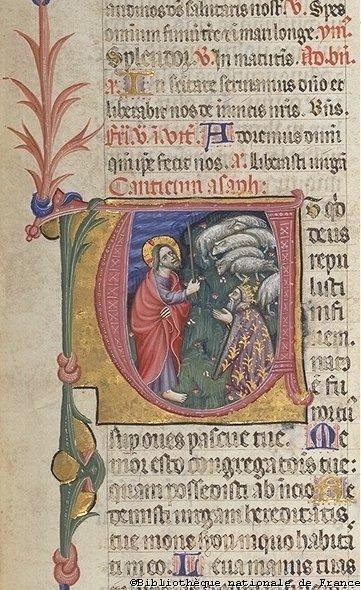 |
| King David at Prayer, 15th century illumination, Unknown Master of the Breviary of Martin d'Aragon, Spain |
|
|
|