Seasons of the Soul: Epiphany Day
... Light from Light You have appeared ...
|
Behold, I give thee gold, that is to say My Divine Love;
frankincense, that is all My holiness and devotion;
finally myrrh, which is the bitterness of My Passion.
I give them to thee to such an extent
that thou mayest offer them as gifts to Me,
as if they were thine own property .
Mechtilde
The Book of Special Grace, Part 1 Chapter 8
Commentary
While this feast celebrates the “manifestation of Christ to the Gentiles” and offers many levels of richness, as a season of the soul, the day of Epiphany offers interesting directions for meditation. Today’s posting offers two of these: the self-offering of God, and the magi as fools. I chose Mecthilde’s prayer: God’s self-offering to her to offer in return. The citing of I Chronicles 29:14 seemed an obvious coda. This text is often recited movingly at the Eucharistic offering – acknowledging that even the bread and wine are God’s own gifts, not ours, lending even more power to what is about to happen when these gifts are consecrated, transformed into Christ’s self-sacrifice. The context of this text is David’s deathbed prayer: “…and of thine own have we given thee” is followed by, “For we are strangers before thee, and sojourners, as all our fathers were; our days on the earth are like a shadow, and there is no abiding.”
And speaking of sojourners, Bernard’s sermon for Epiphany casts the magi as fools, wise fools in the way Paul eloquently unveils the Christian dilemma in I Corinthians 3. The twentieth century Meditations on the Tarot takes up Paul’s image in the chapter on The Fool. It’s worth spending some time with* Bosch’s Adoration of the Magi: here the kings are surrounded by fools and madmen. Projections of how they felt? Real chaos around the crib? Be sure to notice the musicians on the roof – you can practically hear the sackbut. * (Link takes you to Web Gallery of Art, use the search engine: type in Adoration of the Magi and find wonderful things, including the Bosch and details of the painting.)
Quotes
How have wise men become such fools as to adore a child, whose age and whose relations’ poverty alike deserve contempt? They have become fools, that they may be wise. The Spirit has taught them in advance what later the apostle preached, “Let him who would be wise become as a fool, that so he may be wise. For because through wisdom the world in its wisdom could not have knowledge of God, it pleased God by the foolishness of preaching so save them that believe.” … They fall on their faces, they revere Him as King, they worship Him as God. Of a truth He, Who led them hither, has instructed them too; He, Who urged them on by means of the star without, has Himself taught them in their inmost heart. Wherefore this manifestation of the Lord has glorified this day, and the sages; faithful act of worship has rendered it a day to be observed with reverence and love. -Bernard of Clairvaux In Epiphania Domini I.5
|
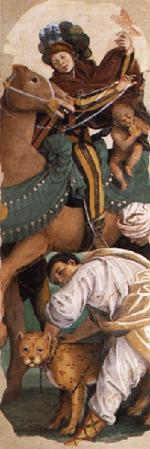 |
| Ferrari, detail from Procession of the Magi, 1544-45 |
|
The crucified Christ
therefore satisfied neither those who were desiring to understand the
world – being only a particular phenomenon amongst other phenomena of
the world – nor those who were awaiting the magical transformative
manifestation of the power of God – the death on the Cross being a
failure and not a triumph of divine power … “a stumbling block to Jews
and folly to Greeks”. But St. Paul did not despair:
“Christ crucified, he said, revealed the power of God and the wisdom of
God to those who are called, both Jews and Greeks, i.e. the Cross of
Christ can be understood only through the cross of revelation (miracle)
and wisdom (immanent Logos). Thus St. Paul set a problem to be solved – or rather a task to be accomplished – by mankind. ...
The “philosopher’s stone” of spiritual alchemy is described in the Emerald Table of Hermes Trismegistus as follows:
The father thereof is the sun, the mother the moon.
The wind carried it in its womb; the earth is the nurse thereof.
It is the father of all works of wonder (thelema) throughout the whole world.
The power thereof is perfect, if it be cast on to earth.
It will separate the element of earth from that of fire, the subtle from the gross, gently and with great sagacity.
It doth ascend from earth to heaven.
Again it doth descend to earth, and uniteth in itself the force from things superior and things inferior.
(Tabula Smaragdina, 4-8)
This
means to say that the process of induction (which “ascends from earth
to heaven”) and that of deduction (which “descends to earth”), the
process of prayer (which “ascends from earth to heaven”) and that of
revelation (which “descends to earth”) – i.e. human endeavour and the
action of grace from above – united and the ascent and descent are
simultaneous and coincide. Meditations on the Tarot: A Journey Into Christian Hermeticism p.606-7
|
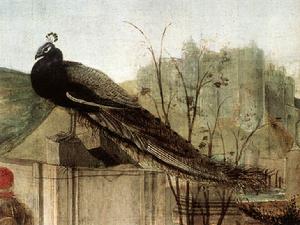 |
| Sandro Bontticelli, Adoration of Magi, detail |
|
|
|
Shall we then yeild him, in costly devotion,
odors of Edom, and offerings divine,
gems of the mountain,
and pearls of the ocean,
myrrh from the forest,
and gold from the mine?
Vainly we offer each ample oblation,
vainly with gifts would his favor secure,
richer by far is the heart’s adoration,
dearer to God are the prayers of the poor.
verses 3-4 of beloved Epiphany hymn
“Brightest and best”
words by Reginald Heber (1783-1826)
All things come of Thee O Lord,
And of thine own
have we given thee.
1Chronicles 29:14
(ca. 4th cent B.C.E.)
|
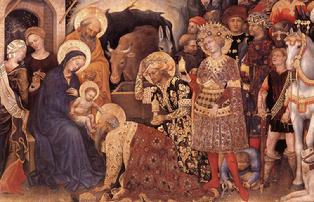 |
| Gentile DaFabriano, Adoration of the Magi, 1423 |
|
|
There is another deeper, more merciful manifestation that God has made of Himself: it is the Incarnation. The divine light, too dazzling to be manifested in all its splendour to our feeble sight, is veiled beneath the sacred Humanity: quod est velamen, is the expression of St. Paul Heb 10:20 … “word that clad Himself in our flesh that through it we may contemplate the Divinity”: Nova mentis nostrae oculis lux tuae claritatis infulsit (preface of the Nativity). … the veil of the Humanity prevents the infinite and dazzling splendour of the Divinity from blinding us. … The soul enlightened by faith knows the splendour hidden behind the veil of this Holy of Holies. Dom Columba Marmion, Christ in His Mysteries p.136
Refering to the Magi gazing at the star, Marmion says, “inward grace of illumination enlightenes their souls.”
|
| Collect for The Epiphany January 6
O God, by the leading of a star
you manifested your only Son
to the peoples of the earth:
Lead us, who know you now by faith,
to your presence,
where we may see your glory
face to face;
through Jesus Christ our Lord,
who lives and reigns with you
and the Holy Spirit, one God,
now and for ever. Amen.
|
|